This blog is intended to go along with Population: An Introduction to Concepts and Issues, by John R. Weeks, published by Cengage Learning. The latest edition is the 13th (it will be out in January 2020), but this blog is meant to complement any edition of the book by showing the way in which demographic issues are regularly in the news.

You can download an iPhone app for the 13th edition from the App Store (search for Weeks Population).

If you are a user of my textbook and would like to suggest a blog post idea, please email me at: john.weeks@sdsu.edu

Showing posts with label What Lies Ahead?. Show all posts

Wednesday, January 16, 2019

Pakistan's Supreme Court Drops "Population Bomb"

The Supreme Court of Pakistan yesterday produced a genuine "wow" moment when they urged the country to strive for a two child per family norm. The Times of India reports that:
Describing Pakistan's rapidly growing population as a "ticking timebomb", the Supreme Court Tuesday urged religious scholars, the civil society and the government to back population control measures, including a two children per family norm, in the Muslim-majority country.
A three-member bench led by Chief Justice Saqib Nisar made the observations during a hearing in a case related to population control in Pakistan, now the world's fifth most populous.
"The increasing population is a burden on the country's resources. It is about the future of the next generation. It would be unfortunate if the population is not controlled. Two children per home will help to control the population. There is a need for a campaign on the matter," the apex court was quoted as saying by the report. "The entire nation needs to stand together to control the population," the chief justice said.
The Pakistan Medical Association (PMA) has also voiced its concern at the rapid increase of population in the country, calling it a looming disaster.
In a recent press statement, the PMA said the birth of 15,000 babies in Pakistan on the 1st day of 2019 was alarming. The PMA thinks that it is a distressing situation as at the moment as 60 per cent of the national population stands below the age of 25 years; 25 million children are not going to school and 90 per cent the population is not being provided with clean drinking water. Malnutrition is another big issue and food scarcity is a big problem, the association said. 
The PMA said it believes that the unchecked rise in the population is a looming disaster, and concrete steps should be taken to implement family planning and make people-friendly economic policies to overcome these difficulties and save the coming generations.
Pakistan has wrestled with the question of family planning for most of its history. During the 1950s and 1960s there were concerted efforts to organize government-sponsored programs, but political instability has undermined their efficacy over time. With any luck, this time will be different. 

Thursday, December 27, 2018

U.S. Population Growth Hits an 80-Year Low

Thanks to Rubén Rumbaut for pointing me to a nice summary of U.S. demographic trends by Brookings Institution demographer William Frey. The U.S. Census Bureau recently came out with its year-end summary of what happened between July 1, 2017 and July 1, 2018, and Bill gets right to the point--we're getting older and slowing down. Yes, I mean all of us, but this applies generally to the U.S. population.
Their data show that the national rate of population growth is at its lowest since 1937, a result of declines in the number of births, gains in the number of deaths, and that the nation’s under age 18 population has declined since the 2010 census. This is on the heels of recently released data showing geographic mobility within the U.S. is at a historic low. And while some states—particularly in the Mountain West—are growing rapidly, nearly a fifth of all states displayed absolute population losses over the past two years.
Here's what it looks like graphically:


As the baby boomers move into the older ages, the number of deaths is increasing, and since younger women are delaying having babies (and may have fewer than previous generations), and fewer immigrants are coming into the country, we are growing very slowly. This is probably good for the environment, but it introduces a lot of potentially unwelcome changes that we may all be coping with for the rest of our lives.
This week’s release of census estimates appears to put an exclamation point on what we should be preparing for as the country ages and grows less rapidly from natural increase. The latest national growth rate of 0.62 percent is noticeably below what we have experienced in decades prior. While it is still far higher than in countries like Germany, Italy, and Japan, it means that policymakers must place increased attention on caring for a larger and more dependent aging population, and dealing with the realities of a slower-growing labor force. In particular, it requires a more serious discussion of U.S. immigration policy because of the future contributions that immigrants will make to growing America’s society and economy.
I couldn't agree more. Immigration policy should be the #1 topic under discussion by Congress when they reconvene--right after they get the budget back on track and continue the funding of the Census Bureau!

Friday, November 23, 2018

Is There a Looming White Minority in the U.S.?

A front page story in today's NYTimes by Sabrina Tavernise has the obviously provocative headline:
"Why the Announcement of a Looming White Minority Makes Demographers Nervous." At issue is the Census Bureau's classification of race and ethnicity, and how that factors into their population projections, and then how people interpret those data. Is the fear (stoked by Census Bureau projections) that Whites are on the verge of becoming a minority group in the country one of the things that has ramped up populist rhetoric?
In a nation preoccupied by race, the moment when white Americans will make up less than half the country’s population has become an object of fascination.
For white nationalists, it signifies a kind of doomsday clock counting down to the end of racial and cultural dominance. For progressives who seek an end to Republican power, the year points to inevitable political triumph, when they imagine voters of color will rise up and hand victories to the Democratic Party.
But many academics have grown increasingly uneasy with the public fixation. They point to recent research demonstrating the data’s power to shape perceptions. Some are questioning the assumptions the Census Bureau is making about race, and whether projecting the American population even makes sense at a time of rapid demographic change when the categories themselves seem to be shifting.
This is not a new topic of conversation. You may recall my blogging about it a few months ago. As Dowell Myers at the University of Southern California said back then, and again in today's story, the Census Bureau defines "white" in a very narrow way that does not take into account the kind of intermarriage that is going on and which, in essence, is continuing to have a "melting pot" effect. The way racial/ethnic categories are defined creates the image of a reality that doesn't reflect the real world. On that point, here is my favorite quote from the story:
Mary Waters, a sociologist at Harvard University [more about her at this blog post], remembered being stunned when she saw the research. “It was like, ‘Oh wow, these nerdy projections are scaring the hell out of people,” she said.
"The question really for us as a society is there are all these people who look white, act white, marry white and live white, so what does white even mean anymore?” Dr. Waters said. “We are in a really interesting time, an indeterminate time, when we are not policing the boundary very strongly."
Why does the Census Bureau even ask these questions? When Richard Nixon was President he wanted to get rid of them, but the argument then, as now, is that they help us track discrimination and other kinds of inequalities. But, are these data more dangerous than helpful? The country needs to have a big discussion about this.

A closely related problem is the extent to which the concern about race/ethnicity gets mixed in with the migration policy issue. Read the interview with Hilary Clinton about migration in today's NYTimes and see what you think...

Sunday, November 18, 2018

Pregnancy Related Deaths Higher in US than any other Rich Country

The New York Times today published an article that fortunately has gotten a lot of attention. It details the tragedies of women and their babies dying because of pregnancy-related problems. To be sure, there is a reason why people have always said that "getting pregnant may be the most dangerous thing a woman can do," but maternal mortality rates have come down dramatically all over the world. Yet, here in the United States the rates are higher than in any other rich country, according to data compiled by the World Health Organization, and they have been going up, not down, according to the U.S. Centers for Disease Control and Prevention. Here's their graph of the trend:


The reason for the increase, and for the fact that the U.S. is higher than other rich countries seems to have a simple remedy--examine every such incident and figure out what went wrong and circulate that information so health practitioners won't keep making the same mistakes. You might think that everyone would want to do that, but sadly you would be wrong.
It wasn’t until 2003 that states started adding a pregnancy check box to death certificates, and some didn’t do so until the past two years. “Thiscreated a data mess where nobody could figure out what the national trends were,” she said. She described this as “a huge missed opportunity for intervention in conjunction with the Millennium Development Goal.” At the same time, “the National Center for Health Statistics, which is the government agency responsible for publishing maternal mortality data, completely stopped publishing it.” 
The only exception in the United States was California, where, in 2006, the Stanford University School of Medicine worked with the state to create the California Maternal Quality Care Collaborative. The initiative developed “quality improvement tool kits” that doctors and hospitals could download. They included detailed instructions about best practices for various preventable complications that can arise during or after pregnancy, like hemorrhaging and pre-eclampsia.
As a result of this initiative, between 2006 and 2013, California saw a 55 percent decrease in the maternal mortality rate, from 16.9 to 7.3 deaths for every 100,000 live births. During that same period, according to The Washington Post, the national rate increased — from an estimated 13.3 to 22 deaths in 100,000.
Next door, in Canada, the rate is 7 per 100,000, and in Switzerland it is 5, just to give you a sense of where the U.S. stands. 

Wednesday, November 14, 2018

People Are Waiting Longer to Get Married

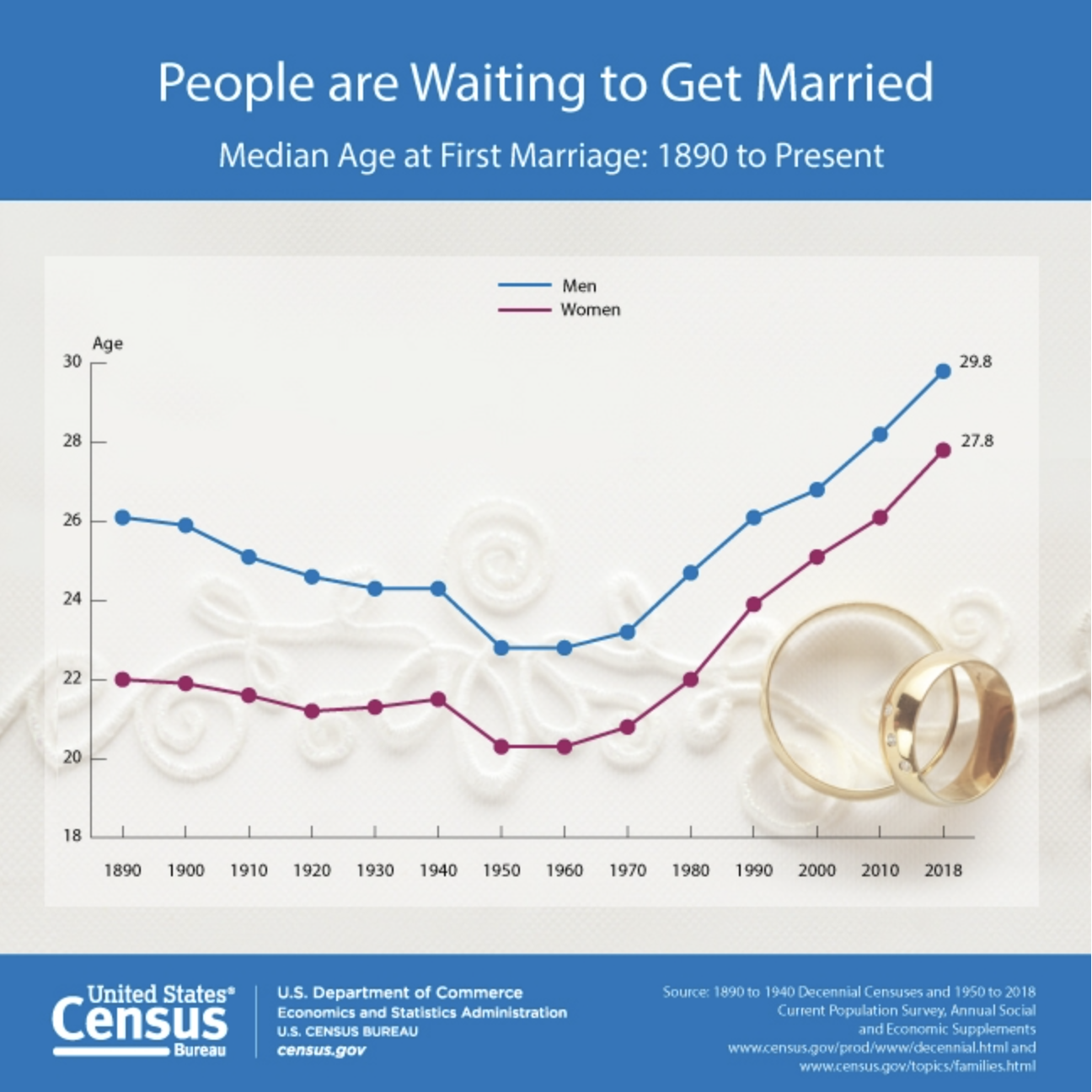
One of the central points raised by the theory of the Second Demographic Transition is that young people in richer countries are growing up with ideas of what to do with their lives besides the time-honored tradition of marrying and having kids. Today the U.S. Census Bureau reminded us of this trend with data from the Current Population Survey. Here's the pattern over time in average age at marriage for males and females in the U.S.:


The graph starts back in 1890 when the rise in the age at marriage (relative to earlier years not shown in the graph) was associated with the beginning of the decline in fertility. This was prior to the advent of effective methods of contraception, so delaying marriage (which in those days also meant delaying the onset of sexual activity) was a way of limiting fertility. The post-WWII period changed all of that and set in motion a round of early marriage and childbearing that produced the baby boomers. But the younger generations have been consistently delaying marriage, although not necessarily delaying sexual activity. In the process, they are creating a very different set of family and household relationships than we've experienced before. This is, of course, why family demography is such a key element in modern social science.

Tuesday, September 18, 2018

Gates Foundation Looks at the Demographics of Extreme Poverty

The Bill & Melinda Gates Foundation has just released this year's "Goalkeepers" report and the focus is on helping children living in areas of extreme poverty. The world needs for these youngsters to grow up healthy and well-educated--not an easy task, but certainly a possible one.
Today’s booming youth populations can be good news for the economy; if young people are healthy, educated, and productive, there are more people to do the kind of innovative work that stimulates rapid growth. This helps explain the amazing progress of the past generation in most of the world, and it is the key to spreading that progress everywhere.
This progress has come in waves. The first wave centered on China; the second wave centered on India. As a result of successes in Asia, the geography of poverty is changing: extreme poverty is becoming heavily concentrated in sub-Saharan African countries. By 2050, that’s where 86 percent of the extremely poor people in the world are projected to live. Therefore, the world’s priority for the next three decades should be a third wave of poverty reduction in Africa.
One of the obstacles the continent faces is rapid population growth. Africa as a whole is projected to nearly double in size by 2050, which means that even if the percentage of poor people on the continent is cut in half, the number of poor people stays the same. Even so, for most African countries, the outlook is positive. For example, Ethiopia, once the global poster child for famine, is projected to almost eliminate extreme poverty by 2050.
As I read the report, I was instantly put in mind of the population projections made over the years by Wolfgang Lutz and his group at the Vienna Institute of Demography that have demonstrated the pretty amazing demographic consequences of education, especially when it equally includes boys and girls and is, of course, taught by well-qualified people. Investing in young people is, as the Gates reports says, an investment in the future of these countries because these are the people who are going to have to be change-makers at the local and regional levels.

Tuesday, September 11, 2018

Tanzania's President Urges Women to STOP Using Birth Control!

CNN has just reported that the President of Tanzania, John Magufuli, has called on women in his country to stop using birth control because the country needs more people. 
"Those going for family planning are lazy ... they are afraid they will not be able to feed their children. They do not want to work hard to feed a large family and that is why they opt for birth controls and end up with one or two children only," he said at a public rally on Sunday. He was quoted in a local newspaper, The Citizen, as saying that those advocating for birth control were foreign and had sinister motives.

Magufuli urged citizens to keep reproducing as the government was investing in maternal health and opening new district hospitals.
Now, for the record, the latest PRB World Population Data Sheet show that the average woman in Tanzania is having 5.2 children. To be sure, this is down from 6 children 20 years ago, but it still means that Tanzania is one of the top 8 countries in the world in terms of population growth over the next several decades. They are projected to increase from the current 59 million to 84 million by 2030 and 138 million by 2050--more than a doubling in scarcely more than three decades! And these projections assume that fertility will drop to about 3.5 children by the middle of this century.

So, the need for women to stop using birth control is obviously bogus. Magufuli argued that:
"You have cattle. You are big farmers. You can feed your children. Why then resort to birth control?" he asked. "This is my opinion, I see no reason to control births in Tanzania," Magufuli, who has two children, said.
The CNN reporter, Stephanie Busari, hints at the real issue--sexism. Males seem to be feeling threatened by increasing control of women over their own bodies and lives. In the meantime, the future of Tanzania almost certainly depends upon women using more birth control, not less.

Tuesday, September 4, 2018

South Korea's Fertility May Drop Below 1 Child Per Woman

Thanks to both Todd Gardner and Stuart Gietel-Basten for almost simultaneously pointing me to a story in yesterday's Guardian suggesting that the fertility rate in South Korea may soon drop to less than one child per woman. This is low-low fertility of nearly unheard of proportions even in what has become a very low fertility region of the world (and check out the brand new 2018 PRB World Population Data Sheet to make those comparisons for yourself!):
The average number of babies born per woman of reproductive age is due to be as low as 0.96 this year, falling below one for the first time in history, according to a study commissioned by the Chosun Ilbo newspaper [that article is in Korean, btw].
Such a low fertility rate is normally only seen during wartime, said Lee Chul-hee, an economics professor at Seoul National University and one of the authors of the study.
“There’s definitely going to be a psychological shock among the Korean people,” he said. “It will likely influence what is considered to be an ideal number of children, and could lead to the rate dropping even further.”
At the end of the Korean War, UN demographers estimate that the TFR in South Korea was above 6 children per woman, but a rapid drop in fertility after that (not unlike the one in Taiwan) brought fertility down to below replacement in the mid-1980s and it has stayed below replacement since then. This has, of course, generated the almost ideal demographic dividend that has helped the country leap into prosperity in a relatively short period of time. 

As is also true in Southern Europe, the birth rate is so low in South Korea at least in part because of the strings that are still tied around the lives of women:
The status of women in South Korea, a deeply patriarchal society, is a major driver of the trend, along with worsening job prospects for young people and rising property prices. Women are getting married and having children later in life, if at all, for fear of being denied promotions and facing discrimination at work.
The average age for South Korean women marrying for the first time is 30.2, according to figures from the ministry of gender equality and family, up from 24.8 in 1990. On average, women have their first child at 31.6.
There are going to have to be some decisive cultural changes--not just simple government policies--if the birth rate is going to get back up closer to replacement level. It can happen, of course, but it won't be easy.


Friday, August 24, 2018

The World Needs For China to Rejuvenate its Plant-Based Diet--UPDATED

I have mentioned before that as China gets richer, the population has been demanding more meat in the diet, especially pork. While the pigs are mainly grown in China, a lot of the food for those pigs is grown elsewhere and imported to China. Since nearly one in five humans lives in China, this is a big deal. The environmental impact of growing food for the pigs and the climate impact from pig waste all are huge problems going forward. 

There may be hope in sight, however, given the prospect of new innovations in plant-based diets in China. The story is from The Economist's 1843 magazine, and I thank my older son, Professor John Weeks, Jr., for pointing it out to me.
In the last few years there has been a rush in demand for vegan and vegetarian foods in Western countries. Much of it is coming from flexitarians – people who have not renounced meat completely but want to cut their consumption. To satisfy them, companies are developing products that look, taste and feel as close as possible to meat and dairy dishes – most famously a plant-based burger made by Impossible Foods that appears to bleed like a rare beef patty.
Amid this flurry of innovation in the West, it’s worth remembering that the Chinese have been using plant-based foods to mimic meat for hundreds of years. In the time of the Tang dynasty (AD618-907), an official hosted a banquet at which he served convincing replicas of pork and mutton dishes made from vegetables; in the 13th century, diners in the capital of the southern Song dynasty (Lin’an, now Hangzhou), had a wide choice of meat-free restaurants, including those that specialised in Buddhist vegetarian cuisine.
The tradition is still alive in contemporary China. In Shanghai, most delicatessens sell rolled-tofu “chicken” and roast “duck” made from layered tofu skin. Restaurants offer stir-fried “crabmeat”, a strikingly convincing simulacrum of the original made from mashed carrot and potato flavoured with rice vinegar and ginger. Elsewhere, Chinese food manufacturers produce a range of imitation meat and seafood products, including slithery “chicken’s feet” concocted from konnyaku yam and “shark’s fin” made from translucent strands of bean-thread noodle.
My wife and I gave up meat 30 years ago when we got our first German Shepherd. It was an animal rights decision, not an environmental impact decision, but over time two important things have happened: (1) our knowledge of the environmental impact (not just the inherent cruelty) of growing animals to kill and eat them has expanded exponentially; and (2) the volume and quality of plant-based diets has expanded exponentially. This latter aspect is a great trend not just for China, but for the entire planet. 

UPDATE: A special report today from Reuters discusses the ecological damage being done in Brazil as it tries to meet China's demand for meat and grain:
Deforestation in the region has slowed from the early 2000s, when Brazil’s soy boom was gaining steam. Still, farmers continue to plow under vast stretches of the biome, propelled largely by Chinese demand for Brazilian meat and grain. The Asian nation is Brazil’s No. 1 buyer of soybeans to fatten its own hogs and chickens. China is also a major purchaser of Brazilian pork, beef and poultry to satisfy the tastes of its increasingly affluent consumers.
Rising trade tensions between China and the United States have only deepened that connection. Brazil’s soybean exports by value to China are up 18 percent through the first seven months of the year as Chinese buyers have canceled tens of millions of dollars’ worth of contracts with U.S. suppliers.

Tuesday, August 21, 2018

Gen Z about to Outnumber Millennials Globally

Thanks to Todd Gardner for the link to a story in Bloomberg about their analysis of data from the United Nations Population Division in which they find that, at the global level, members of Generation Z are projected to outnumber Millennials by next year. Here we have demographic metabolism on display:
Gen Z will comprise 32 percent of the global population of 7.7 billion in 2019, nudging ahead of millennials, who will account for a 31.5 percent share, based on Bloomberg analysis of United Nations data, and using 2000/2001 as the generational split.
Does that matter? With social, political, and economic changes taking place at a pretty rapid pace it almost certainly affects you to be growing up in a "different world" than previous generations.
Gen Zers have never known a non-digital world and have grown up amid events such as the "war on terror" and Global Recession. "The key factor that differentiated these two groups, other than their age, was an element of self-awareness versus self-centeredness," according to “Rise of Gen Z: New Challenge for Retailers,” a report by Marcie Merriman, an executive director at Ernst & Young LLP. Millennials were "more focused on what was in it for them. They also looked to others, such as the companies they did business with, for solutions, whereas the younger people naturally sought to create their own solutions."
There are two things to keep in mind in thinking about this generational transition. The first is that it is occurring earliest in developing countries that have higher birth rates and thus a younger age structure, as you can see in the map below:


And the second point is that not everyone agrees on the exact definition of the generations.
For this Bloomberg comparison, millennials were defined as people born in 1980 through 2000, with Gen Z classified as anyone born starting in 2001 -- at least until the next meaningful cohort emerges. The U.S. Census Bureau also bookends the generations at the end of 2000.
William Strauss and Neil Howe, American historians and authors who first coined the term "millennials," use 1982 and 2004 as the cutoff years. The Pew Research Center defines those born in 1981 through 1996 as millennials, a time-frame also used by Ernst & Young in the survey Merriman wrote about.
Finally, note that there is money to be made in these kinds of comparisons for those who provide advice based on demographic trends--this is a great example of applied demography.

Monday, August 13, 2018

China Now Pushes For More Children

A story this weekend in the NYTimes discusses new moves by the Chinese government to encourage a rise in the birth rate, since the continued low birth rate is leading to a rapidly aging and eventually declining population. The one-child policy has been scrapped in favor of a two-child ideal, but Chinese couples are not hopping on the baby wagon in great numbers.

Now, keep in mind that fertility was already declining pretty rapidly in China before the implementation of the one-child policy back in the late 1970s, so the government may have helped to lower the birth rate, but its nasty, repressive policies were not the underlying cause of the low birth rate. This is at least one reason why lifting the one-child policy hasn't yet encouraged an increase in the birth rate. So, it may be that the government is going to get nasty again.
The new campaign has raised fear that China may go from one invasive extreme to another in getting women to have more children. Some provinces are already tightening access to abortion or making it more difficult to get divorced. 
“To put it bluntly, the birth of a baby is not only a matter of the family itself, but also a state affair,” the official newspaper People’s Daily said in an editorial this week, prompting widespread criticism and debate online.
A plan to end the two-child limit was floated during the legislative session in Beijing last spring and now appears to be under consideration with other measures, the National Health Commission said in a statement.
Experts say the government has little choice but to encourage more births. China — the world’s most populous nation with more than 1.4 billion people — is aging quickly, with a smaller work force left to support a growing elderly population that is living longer. Some provinces have already reported difficulties meeting pension payments.
It is unclear whether lifting the two-child limit now will make much of a difference. As in many countries, educated women in Chinese cities are postponing childbirth as they pursue careers. Young couples are also struggling with economic pressures, including rising housing and education costs.
It is my hope that these and related issues are being discussed among demographers attending this year's American Sociological Association meetings in Philadelphia. I'm sorry I can't be there to contribute. 

Wednesday, July 11, 2018

World Population Day 2018

Today is World Population Day, the theme of which this year is "Family Planning is a Human Right." It is genuinely sad to think we have to keep emphasizing that point, rather than all of us just taking it for granted. Another thing we typically take for granted is being alive, but I missed last year's World Population Day celebration because I was in the hospital intensive care unit as a whole team of physicians (several of them immigrants, I should point out) saved my life when I came down with sepsis (cause still unknown). So, I am very grateful to be here thinking about the 8th anniversary of this blog. 

Back in 2010 the world's population was getting very close to the 7 billion mark (which we hit the next year in 2011). As of today, the Census Bureau's population clock estimates that we are at 7.5 billion. So, in the eight years that I have been blogging, we have added 500 million people to the planet (and, no, I am not to blame for that!). Other demographic trends have been moving in the right direction during this time. The UN Population Division estimates that since 2010 the world's total fertility rate has dropped from 2.57 to 2.47, while life expectancy at birth (both sexes combined) has gone up from 69 to 72. 

We have to remember, though, that the medium variant of the UN population projections suggests that the world's population will continue to grow until at least to the end of this century, and that takes into account expected declines in fertility and mortality. Those things are not likely to happen automatically, however. We need to stay active in the pursuit of those improvements in the quality of life all over the globe.

Tuesday, July 10, 2018

Getting Ready for World Population Day

Tomorrow (June 11th) is World Population Day, as proclaimed by the United Nations back in 1989. In preparation for that event, two very interesting articles have been posted to the Conversation. The first one is from Andrew Hwang, a mathematician at the College of the Holy Cross: "7.5 billion and counting: How many humans can the Earth support?" His ideas will be very familiar to you if you've read my book.
Humans are consuming and polluting resources – aquifers and ice caps, fertile soil, forests, fisheries and oceans – accumulated over geological time, tens of thousands of years or longer. Wealthy countries consume out of proportion to their populations. As a fiscal analogy, we live as if our savings account balance were steady income. According to the Worldwatch Institute, an environmental think tank, the Earth has 1.9 hectares of land per person for growing food and textiles for clothing, supplying wood and absorbing waste. The average American uses about 9.7 hectares. These data alone suggest the Earth can support at most one-fifth of the present population, 1.5 billion people, at an American standard of living.
A related article by Derek Hoff, an historian at the University of Utah (and author of a very interesting book titled The State and the Stork: The Population Debate and Policy Making in US History) focuses on the Neo-Malthusianism of Paul Ehrlich, but essentially draws the same conclusion as Hwang. The title of Hoff's article is "A long fuse: ‘The Population Bomb’ is still ticking 50 years after its publication".
“The Population Bomb” created more space to hold radical views on population matters, but its impact was fleeting, and maybe even harmful to the population movement. By the early 1970s, many critics were savaging Ehrlich and the larger goal of achieving zero population growth. And the politics of “morning in America” in the 1980s successfully marginalized Erhlich as a doomsdayer. 
But he got much right, even if many details and his timing were off. Global population has increased at a remarkably steady rate since 1968, and the United Nations projects that it will reach 9.8 billion by 2050 and 11.2 billion by 2100. Scientists continue to extend his prescient warnings that efforts to feed all these people through pesticide-intensive monoculture may backfire. And although Ehrlich exaggerated the threat of mass starvation, about 8,500 young children die from malnutrition every day.
Human-driven climate change is an overriding threat, and is unambiguously worsened by population growth. The Intergovernmental Panel on Climate Change estimates that limiting warming in this century to 3.6 degrees Fahrenheit (2 degrees Celsius) would require cutting global greenhouse gas emissions 40 to 70 percent by 2050 and nearly eliminating them by 2100. “Globally, economic and population growth continue to be the most important drivers of increases in CO2 emissions from fossil fuel combustion,” the panel observes.
The point of both articles is that the problem is not simply that the number of humans has exploded in the past 100 years. For the very same reasons that we were able to dramatically reduce death rates (and thus unleash population growth) we have figured out how to dramatically increase our standard of living. What we haven't yet figured out is how even all of us currently alive can sustain our current level of living, much less continue to increase it.

Monday, July 9, 2018

Japan is Admitting More Immigrant Workers--Very Cautiously

Japan has entered its long-expected decline in population, and this seems finally to have awakened the idea that immigrants might be useful to the economy. A story in this week's Economist shows the tentative steps being taken.
Acceptance of foreign labour is gradually increasing in Japan, one of the world’s most homogenous countries, where only 2% of residents are foreigners, compared with 16% in France and 4% in South Korea. A poll conducted last year found opinion evenly split about whether Japan should admit more foreign workers, with 42% agreeing and 42% disagreeing. Some 60% of 18-29-year-olds, however, were in favour, double the share of over-70s.
Whatever Japanese think of them, foreign workers have become a fact of life, at least in cities. There are 1.3m of them, some 2% of the workforce—a record. Although visas that allow foreigners to settle in Japan are in theory available only to highly skilled workers for the most part, in practice less-skilled foreigners are admitted as students or trainees. The number of these has been rising fast. Almost a third of foreign workers are Chinese; Vietnamese and Nepalese are quickly growing in number.
Pressure from business lies behind the change in attitudes, both societal and official. Over the past 20 years the number of workers below 30 has shrunk by a quarter. In addition, the ageing population is creating jobs that few Japanese want at the wages on offer, most notably as carers. There are 60% more job vacancies than there are people looking for work. Industries such as agriculture, construction and nursing are increasingly dependent on foreigners. Some 8% of Sakura no Mori’s staff are foreign, as are 7% of workers at 7 Eleven, Japan’s biggest convenience-store chain. 
The government does not allow these immigrants to bring in family members and many are required to frequently renew their visas, presumably so that the government could send them home at any time. In most jobs they must also become fluent in Japanese which, unlike English, is not regularly learned in countries outside of Japan. It is likely that as the demographic pressure increases over the next few decades, the walls built up against immigration will have increasingly larger cracks in them.

Sunday, July 8, 2018

White Americans Are NOT Close to Minority Status

The idea that white Americans are on the verge of no longer being the majority in this country has taken root in the media and in the minds of an awful lot of people. This theme was once again pushed out to the public a couple of weeks ago by William Frey, a demographer at the Brookings Institution. I have known Bill for a long time and he is a very good demographer, but I hadn't blogged about his report because it troubled me--the data he was using--even though from the U.S. Census Bureau--just didn't quite square with my own impression of what is happening demographically. Thanks to my long-time friend, Rubén Rumbaut at UC, Irvine, for pointing me to an "open letter" from Dowell Myers at the University of Southern California in which Dowell summarizes his very important work on this problem:
Most of us are using the same analysis procedures this year as we did back in the 1990s, even though the Census Bureau totally overhauled their racial definitions and measurements in 2000. Now that we are nearing the end of the second decade of the 21st century, why would demographers still be using racial binaries (white vs. nonwhite) and mutually exclusive categories? At best, the public analysis I see reported only uses half of the available race data, the half that comes closest to the oldest idea of race in America, namely the “one drop” rule, that says any portion of nonwhite blood makes a person nonwhite, no matter what is their mother or father’s race or no matter how they truly identify.
Let me share exactly where I am coming from, because this was reported in two publications recently, one in the Annals of the American Academy of Political and Social Science, the other in the Washington Post (both co-authored with the political scientist Morris Levy). The Annals study, part of the May issue, devoted to “what Census data miss about American diversity,” reviews the changes in Census Bureau race projections since 2000 and tests the impacts of alternative versions of reporting on a randomized sample of white voters. It received favorable coverage in outlets ranging from Vox to Reason.com.
Many data consumers do not know that the Census Bureau actually tracks six definitions of white in their projections. There is a larger, inclusive count of each race and a smaller, more exclusive count, the latter having subtracted out all whites who also identify with another race (people such as Meghan Markle, who has a white father and black mother, and now is a member of the British royal family.)
The Census Bureau knows this problem of racial classification and handles it by reporting both exclusive and inclusive definitions of white. You can see the latest projections comparing these numbers out to 2060 here. [Go to Table 5]. It is up to the users to decide which version of white is best.
Thus, if we follow the Census Bureau's guidelines that Hispanic is an ethnicity, not a race, and if we accept the idea that many people of mixed race also include themselves as white, then we see that the Census Bureau estimated that in 2016, 79% of the U.S. population considered themselves to be white, compared to the non-Hispanic one-race only definition by which 61% were white. Then, using the very restricted definition of white, by 2045 whites would drop to slightly less than 50% of the population. However, by the inclusive definition of whites, by 2060 (the end date for the current Census Bureau projections) whites are still 74% of the population.

To put it another way--the melting pot is working and whites are not on the way out the door in this country. 

Tuesday, July 3, 2018

Demography of Aging Revisited

Yesterday I blogged about health disparities in the United States, referencing research by Jennifer Montez and Mark Hayward. The latter comes up again today, because he organized a workshop on the demography of aging for the National Academy of Science (NAS) from which the report has just been made available. Aging and health go together, of course. We wouldn't give nearly as much attention to aging as we do were it not for the fact that our health tends to deteriorate as we age. That is a personal problem, but one that our family and friends and, indeed, the entire society, winds up coping with. Our entire life course is very much influenced by health, as Mark Hayward makes clear in the introduction to the volume:
Changes in fertility, life expectancy, and population-age structure have had profound effects on the opportunities and constraints facing individuals, their families, and their communities. The older population has become more racially/ethnically diverse. Kin relationships have become more complex and fluid, and more people now approaching old age have been divorced and many have never been married. Population health now spans a web of health processes including biological risk, disability, cognition, and disease. The health and well-being of the older population are now seen as the consequences of long-run and cumulative effects of social, economic, and contextual factors over the entire life course.
The participants in the workshop, each with a chapter in this volume, are among the big names in the demography of aging, and this is a deliberate followup to a previous (1994) NAS report on the Demography of Aging. We know a lot more than we did then, thanks in part to the funding of research by the National Institute on Aging, and much of that learning tells us that the world is more complicated than we thought it was 24 years ago. This new volume dives into those complexities. Each chapter would be worthy of a blog post, but you should read it for yourself because if you are reading this you are aging, and you should know what lies ahead.

Sunday, June 24, 2018

We Need Immigrants, Even if Some People Wish We Didn't

The headlines for the past week have all been about the Trump administration's horrific "zero-tolerance" policy at the U.S.-Mexico border that separated children from their parents, seemingly in an attempt to (a) deter potential migrants from coming; and (b) using those children as political pawns. Of course, this was just the latest move in Trump's anti-immigrant agenda, which was a key part of his presidential campaign platform. Donald Trump is not really against immigrants, of course. After all, his grandfather was an immigrant from Germany, his mother an immigrant from Scotland, and two of his three wives were immigrants from Eastern Europe. His is a racist attitude, opposed to immigrants from Latin America, the Middle East, and Africa. And, speaking of Europe, there is of course a lot of anti-immigrant sentiment there, aimed largely at immigrants from the Middle East and Africa. These are moral issues, not just political issues, as noted in this week's Economist.
Take the White House’s approach, which resulted in 2,342 children being separated from their families last month. To use children’s suffering as a deterrent was wrong. It is the sort of thing that will one day be taught in history classes alongside the internment of Japanese-Americans during the second world war. To argue that the administration had to act in this way to uphold the law is false. Neither George W. Bush nor Barack Obama, who deported many more people annually than Mr Trump, resorted to separations. To claim it was necessary to control immigration is dubious. In 2000 the government stopped 1.6m people crossing the southern border; in 2016, when Mr Trump was elected, the numbers had fallen by 75%. Deterrence no doubt played its part, but prosperity and a lower birth rate in Mexico almost certainly mattered more. No wonder, after a public outcry, Mr Trump abandoned the policy.
Other examples of deterrence have fared no better. Britain’s government concluded from the Brexit referendum that it should redouble efforts to create a “hostile environment” for immigrants. It ended up sending notices to people who had arrived in Britain from the Caribbean in the 1950s, ordering them to produce documents to prove they were British. The harassment, detention and deportations that followed resulted in the resignation of the home secretary. Likewise, in 2015 European governments argued that rescuing boats carrying migrants from north Africa merely encouraged more to risk that journey. Then as many as 1,200 people drowned in ten days, and Europeans were horrified at the cruelty being meted out in their name. European leaders concluded that voters were not pro-drowning after all.
The anti-immigrant sentiment is very short-sighted in the United States and throughout Europe. The post-WWII baby booms were followed by declines in fertility that helped create demographic dividends in these areas. Those birth rates are not going to back up to previous levels, even though in Southern and Eastern Europe they probably would climb closer to replacement level is gender equity were more widely practiced. But, most importantly, the demographic dividends were not used wisely. Governments did not save up in order to cope with an aging population. Rather, they lowered taxes to support a growing population of billionaires and exacerbating income and wealth inequality. A lot needs to happen to get things right again, but at least in the short term immigrants provide a ready source of bail-out labor and taxable sources to pay for pensions and health care for the rapidly aging populations. That isn't sufficiently appreciated by people living in places like retirement communities in Florida, as detailed yesterday in a PoliticoMagazine.com story.

Thursday, June 21, 2018

White Deaths Exceed White Births in 26 States

Thanks again to Professor Rubén Rumbaut for linking me to NYTimes story about a new study just out by another long-time friend, Professor (well, actually Dean) Rogelio Sáenz at the University of Texas, San Antonio. He and another demographer, Professor Kenneth Johnson, published a Research Brief for the Applied Population Lab at the University of Wisconsin that tells an important part of the story about changing American demographics. Sabrina Tavernise of the NYTimes provides a good summary:
Deaths now outnumber births among white people in more than half the states in the country, demographers have found, signaling what could be a faster-than-expected transition to a future in which whites are no longer a majority of the American population.
The Census Bureau has projected that whites could drop below 50 percent of the population around 2045, a relatively slow-moving change that has been years in the making. But a new report this week found that whites are dying faster than they are being born now in 26 states, up from 17 just two years earlier, and demographers say that shift might come even sooner.
“It’s happening a lot faster than we thought,” said Rogelio Sáenz, a demographer at the University of Texas at San Antonio and a co-author of the report. It examines the period from 1999 to 2016 using data from the National Center for Health Statistics, the federal agency that tracks births and deaths. He said he was so surprised at the finding that at first he thought it was a mistake.
Here is the picture state-by-state:


Before we decide how this affect the future politics of the United States, we have to account for a couple of things. The first is that many births are to parents of different race/ethnicity. Thus intermarriage--which is historically what the melting pot is all about--could affect cultural and political attitudes in unpredictable ways. And, secondly, as I noted in discussing Wong's book about the demographics of immigrants and evangelicals, you cannot automatically assume a person's political views from their race/ethnicity. 

UPDATE: When thinking about these data keep in mind the authors' note that: "NCHS data do not allow for classification of multiple-race births or deaths—so all births are classified into one race category, that of the infant's mother; the race and Hispanic origin of the infant's father are not considered." For more on why this matters, see this more recent blog post of mine.

Sunday, June 10, 2018

Should Countries Enforce Population Control?

An opinion piece with this evocative title was published over the weekend by Ozy.com encouraging people to weigh in with their own opinions.  I'm guessing that the whole topic was inspired by the a book titled "Choosing Daughters: Family Change in Rural China," by Lihong Shi, an anthropologist at Case Western Reserve University, since much of the written space is given over to China's one-child policy. The editors also seem to accept the somewhat controversial analysis of David Goodkind that the one-child policy averted 400 million births in that country. As I said when that issue first emerged: "The one-child policy was a human rights disaster and, in my view, was not necessary to the drop in fertility in China. The Chinese were going to avert those births with or without that policy."

The title of the article suggests that "population control" means population limitation, with references to trying to limit births in China and India, and also getting into sterilization programs among mentally-ill people that arose during the social Darwinist movement early in the 20th century. However, if you watch the video of people interviewed on the street somewhere, you actually see a more nuanced view of "control." Human society controls many aspects of demographic change in ways that both encourage and discourage population growth. For example, we regulate human fertility by regulating age at marriage, and often by limiting your options once you are married, limiting incestuous sexual relationships, controlling access to contraception and abortion, as well as access to health providers who might be able to save lives were they more available. We allow access to guns that can kill people, but delay our reaction to finding lead or other contaminants in the water (keeping in mind that clean water is essential to human health). We control access to toileting and sewerage. We control who can come into and, in some cases, who can leave countries. In other words, as humans we control aspects not just of fertility, but mortality, and migration as well. Some of these regulations encourage lower rates of growth, at least in local places, and others encourage higher rates of growth. 

In my view, the bottom line is that a successful future for human society requires giving each of us as much control as possible over our own lives, especially in terms of reproduction and health and the ability to move where we want at least within our own country, but always keeping in mind that humans are a social species and we need to have a set of rules ("laws") that we can agree upon and make sense to us. A key element of this kind of "positive" control is education and on this point I am in 100% agreement with the Ozy.com conclusion: "Educating and empowering women just might save us all".

Friday, May 25, 2018

Hungarian Prime Minister Blames Low Fertility on "Liberal Democracy"

According to a report today from US News and World Report, the Hungarian government is blaming its low fertility and declining population on liberal democracy, and it intends to fight back.
Hungary's government will launch measures to stop and then reverse a demographic decline by 2030, Prime Minister Viktor Orban said on Friday, as he blamed liberal democracy for undermining traditional families.
Orban said the key question was whether the Hungarian nation was preserved "biologically and in numbers" and what the government should do to stop the demographic decline. He said the government would launch a "serious family policy action plan" but did not go into detail.
Liberal democracy had failed to halt immigration, protect Christian culture or strengthen the traditional family of one man and one woman, Orban said.
"Christian democracy protects us from migration, defends the borders, supports the traditional family model of one man, one woman, considers the protection of our Christian culture as a natural thing," he said.
Orban, 54, took power in 2010 and has continually increased his control over the media, put allies in charge of once-independent institutions and campaigned on a platform of fierce hostility to immigration.
This seems more like a rant against Muslim immigrants than anything else, especially since low fertility and population decline have been characteristics of the entire Central and Eastern European region for a long time. Hungary's next-door neighbor, Romania, has been experiencing similar trends and a paper just out in Demographic Research by two Romanian demographers suggests, somewhat ironically, that the best route to higher fertility in Romania is by increasing the levels of female labor force participation which can increase economic development and make it easier for couples to be able to afford children. This is probably not what the Hungarian Prime Minister wants to hear, but it just might work.