This weekend's NYTimes included a widely-read opinion article titled "The End of Babies," which lamented the low birth rate in the richer countries. As of this writing, the article had almost 1,400 comments (and I admit that I have read only a few of them). The writer, Anna Louie Sussman, dives into the issues surrounding the Second Demographic Transition without seeming to know that this is what she is doing.
As of yet, no one has come up with a single answer as to why so many countries now have below-replacement level fertility, and this is largely due to the unprecedented demographic situation in which we find ourselves. Never before in human history have death rates been so low, nor have women (and men) had such control over reproduction. Both of those phenomena have become associated with greater gender equality than ever before. Yes, we still have a long way to go, but things are moving in the right direction. It is easy to forget that Margaret Sanger started a world-wide movement for female reproductive rights because of the unwanted pregnancies (and attempted abortions) that she saw so often in the slums of New York City a hundred years ago.
In other words, we need to relish the fact that childbearing is now a choice. It is not something that societies demand of couples in order to counter the high death. And, increasingly it is not something that a man can foist on a woman whether she wants it or not. Furthermore, as the writer herself notes, it is not something that any longer requires having sexual intercourse with a man! These are genuinely revolutionary times in which we live. We are not living in a time associated with the end of babies (remember that there are still about a million more babies born each year in the U.S. than there are people dying). We are living in a time of choices, and that's a good thing.
The combination of lower mortality and lower fertility has, of course, altered the age structures of all modern societies. In particular, the populations of most countries are aging. But, rather than lament that fact and long for the days of higher birth rates (which the world really cannot afford), we need to adjust to these new realities of changing age dynamics, and gain a better understanding of how age structures influence politics and the economy. A good place to start getting your head around this is with the work of political demographer Richard Cincotta.
Showing posts with label Introduction to Demography. Show all posts
Showing posts with label Introduction to Demography. Show all posts
Monday, November 18, 2019

Tuesday, November 12, 2019
Educational Level as a Key Predictor of Human Well-Being
Yesterday I was scheduled to be in Vienna presenting a paper on "Educational Level as a Key Predictor of Human Well-Being" at the Wittgenstein Centre on Demography's Conference on Demographic Aspects of Human Wellbeing. Unfortunately, a cabin crew strike at Lufthansa Airlines scuttled my travel plans and so I wasn't there after all. However, thanks to the efforts of the conference organizers, I was able to record my presentation and it played while my slides were being shown. My thanks to Dr. Raquel Guimaraes for sharing some photos of that on Twitter!

I was using data from the Women's Health Survey of Accra (WHSA) that my colleague Dr. Allan Hill (now at Southampton University in the UK) and I (and many other important collaborators) organized in Accra, Ghana a few years ago. You can find details of the project at the SDSU International Population Center website.
The talk was based on the postulates that good health is the single best (even if clearly not the only) measure of human well-being, and that education is the single most important reason for better health. I tested these ideas with our Ghana data, showing that both self-reported health and biometrically-measured health vary in predictable ways by educational level. Here is a sample of the findings:


I was using data from the Women's Health Survey of Accra (WHSA) that my colleague Dr. Allan Hill (now at Southampton University in the UK) and I (and many other important collaborators) organized in Accra, Ghana a few years ago. You can find details of the project at the SDSU International Population Center website.
The talk was based on the postulates that good health is the single best (even if clearly not the only) measure of human well-being, and that education is the single most important reason for better health. I tested these ideas with our Ghana data, showing that both self-reported health and biometrically-measured health vary in predictable ways by educational level. Here is a sample of the findings:

Friday, November 8, 2019
Would China's Population Be Even Smaller Had There Been No One-Child Policy?
For many years, the accepted wisdom in the world has been that China's one-child policy was the reason for the rapid decline in that country's birthrate. In the last several editions of my Population text, I have questioned that assumption, noting the incredible similarity between the fertility trajectories in China and its geographically and culturally close neighbor Taiwan (indeed, close enough that China claims it as its own). Here is my graph from the 13th edition of Population, which will be out very soon:

Given my history with this issue, I was very interested to read a paper by Stuart Gietel-Basten and his colleagues that was published just this week in PLOS/ONE: "Assessing the impact of the “one-child policy” in China: A synthetic control approach." They use a set of sophisticated demographic techniques to make the case that fertility might have declined even more quickly in the absence of the one-child policy--albeit in the continued presence of the wan xi shao ("later, longer, fewer") campaign launched a few years prior to the one-child policy. Here is their summary graph:


Given my history with this issue, I was very interested to read a paper by Stuart Gietel-Basten and his colleagues that was published just this week in PLOS/ONE: "Assessing the impact of the “one-child policy” in China: A synthetic control approach." They use a set of sophisticated demographic techniques to make the case that fertility might have declined even more quickly in the absence of the one-child policy--albeit in the continued presence of the wan xi shao ("later, longer, fewer") campaign launched a few years prior to the one-child policy. Here is their summary graph:

The implication of their findings is, of course, that a faster decline in fertility would actually have produced fewer people in China than there are now. Their results also help to explain why fertility has not risen in China despite the official end of the one-child policy. This is an important article regarding population policy, and I strongly recommend it to you.
Wednesday, September 25, 2019
Remembering Past PAA President Sidney Goldstein
The arrival today of the latest IUSSP newsletter brought the news about the death last month of Sidney Goldstein, who was president of the Population Association of America back in 1976. He died just one day after celebrating his 92nd birthday. He had retired to Lexington, Kentucky, although most of his career was spent at Brown University, where he helped establish, and then directed, their Population Studies and Training Center. This has long been an important resource in demography, as another Past PAA President, Robert Moffitt, recently discussed in his interview with the PAA History Committee. Here's a nice synopsis of some of Goldstein's important work in demography:
Sid’s specific area of interest was the migration of people within countries, especially their movement from rural to urban areas. Beginning with analyses of migration in the United States and Denmark, his focus shifted to less developed countries, including Thailand, China, Vietnam, Ethiopia, Guatemala, and South Africa. In each case, he was especially interested in the impact of rural-urban migration on the welfare and life patterns of the migrants and how they differed from those who were residentially stable. An important component of his work in these countries was the development of local expertise, so that the work that he had begun could be carried further by in-country researchers.You can read more about his professional life in an interview that Jean van der Tak, former PAA Historian, conducted with him many years ago. It is on the website of the Population Association of America (it starts on page 313 of that document). Check out this rather amazing exchange between Jean (VDT) and Sidney Goldstein:
VDT: And you went through your Ph.D. program in just two years. You got the degree in 1953.
GOLDSTEIN: Was it that soon?
VDT: Yes. And Charlie Westoff and Richard Easterlin got Ph.D.s at Penn the same year.
GOLDSTEIN: Right. I still have movies of that commencement, in which the three of us are marching together down the line.
VDT: You marched together a long way in the same field.
GOLDSTEIN: I always thought that was symbolic. I've often thought back to that commencement, the three of us being together. And a number of years later, the three of us were presidents of PAA almost consecutively [Westoff, 1974-75; Goldstein, 1976-77; Easterlin, 1978].
Tuesday, September 10, 2019
Immigration: A boon or Burden to U.S. Society?
Last May, the University of California, Santa Barbara, hosted a debate on "Immigration: A Boon or Burden to U.S. Society?" The debate featured my good friend, Rubén Rumbaut, Distinguished Professor of Sociology at UC, Irvine, and genuinely one of the world's foremost authorities on immigration, especially to the United States. He was debating Mark Krikorian, who is Executive Director of the Center for Immigration Studies, which is an anti-immigration organization based in Washington, DC. Most importantly, Krikorian's ideas have been picked up by Donald Trump and have clearly influenced Trump's approach to immigration. [Indeed, because of his anti-immigrant influence on Trump, there were a lot of protesters outside the auditorium as the debate was taking place.] The moderator of the debate was Donald Kerwin, Jr., Director of the Center for Migration Studies of New York, which is a nonpartisan migration-oriented think tank in New York City. Among their activities is the publication of the academic journal International Migration Review (and, full disclosure here--Professor Rumbaut and I have published in that journal).
We have been waiting all this time for the promised video of the debate to be made public and that has just happened. It is now available as a YouTube video through UCTV. I encourage you to watch this. It is a great inspiration for discussion. Keep in mind, though, that it is about an hour and a half, although of course you can scroll through it, if you have to.

We have been waiting all this time for the promised video of the debate to be made public and that has just happened. It is now available as a YouTube video through UCTV. I encourage you to watch this. It is a great inspiration for discussion. Keep in mind, though, that it is about an hour and a half, although of course you can scroll through it, if you have to.

Friday, September 6, 2019
PAA History Through the Eyes of Past PAA President Robert Moffitt
PAA HISTORY
Interview with Past PAA President Robert Moffitt
By John Weeks, PAA Historian and the PAA History Committee: Win Brown, Karen Hardee, Dennis Hodgson, and Emily Merchant
At this year’s annual meeting in Austin, the PAA History Committee had the privilege of interviewing Dr. Robert Moffitt, who was PAA President in 2014, for the PAA Oral History Project. Dr. Moffitt is the Krieger-Eisenhower Chaired Professor in the Department of Economics at The Johns Hopkins University. He is also Professor, Depart- ment of Population, Family, and Reproductive Health, School of Public Health, Johns Hopkins University. He received his BA in Economics from Rice University, and MA and PhD in Economics from Brown University. He has taught at the University of Pennsylvania, Rutgers University, Brown University, and since 1995 at The Johns Hopkins University.
In the following excerpt, he gives us his overview of how the PAA has changed over time:
I think my first PAA was in the 1980s. I think it wasn’t until I went to Brown and I met all the demographers there. Sid Goldstein had been President of PAA back in 1975 and was very well connected to it and so was Fran Goldscheider and [current PAA President] John Casterline. Of course, PAA is a great organization and not only on scholarship; a great thing about PAA is its collegiality and the personal nature of it, which I’ve never found in any other association.
The field has definitely changed from my initial study of it. When I first got interested in demography back in the Mathematica years [when he was working as a researcher at Mathematica]—so that was the late 1970s— even then, it was pretty much dominated by population control and family planning and related kind of issues. Those were important issues. But the social demography side was really in its infancy and the big change that I see, particularly from my perspective, is the growth of social demography. You come to the PAA this year and the number of sessions on that topic or something related to it is tremendous. And, as a whole, the field of demography has broadened out away from those core issues of fertility, mortality, and migration.
You come to PAA today and you’ve got health and population health, for example. You’ve got applied demographers. You’ve got geographers. You’ve got survey issues and survey statisticians, although the Census Bureau has always been involved. You’ve got economists, of course, here. You’ve got anthropologists. It’s a big tent and that’s a nice thing about demography. Although I have to say that you’ve got to expect a little bit of tension between the traditionalists who say “this is what demography should be” and the younger people who say, “No. I want to do this. It’s not quite the traditional stuff. I want to bring this in.”
The big tent, with a lot of different disciplines represented at the PAA is, I think, very healthy. I also think that it’s one reason for the vibrancy and intellectual excitement of demography. Four thousand submissions this year. It’s amazing how many people come and many young demographers are interested in all different aspects of the field. This is why it is thriving and why the broadening out brings so many people to PAA. It’s the reason that PAA has succeeded.
But demography has gone through a tremendous evolution. Even when I went to Johns Hopkins, it was still Johns Hopkins—a place excelling with demographers working on population control. It still has people like Stan Becker, a distinguished demographer who works on those issues. But [Past PAA President] Andy Cherlin is there, too, and he is representative of social demography—he is concerned with inequality, poverty, and marriage. The tremendous development has been very healthy, in my view.Moffitt also discussed the way in which his career evolved, leading to his recent participation in a committee of the National Academy of Sciences chaired by Past PAA President Greg Duncan that issued a very important report this Spring on how to reduce child poverty by 50% in ten years.
The entire interview is available on the PAA website.
Wednesday, January 2, 2019
Top Ten Posts for 2018
As I do at the beginning of each year, I have taken a look back at the most popular of my posts in the past year. Who are the winners among the 175 that I posted in 2018, based on the number of hits on each one? Here are the Top Ten:
1. Over the years I have been very impressed that the Bill and Melinda Gates Foundation has been moving into the mainstream of demographic trends. Initially they focused especially on childhood diseases, with a special emphasis on malaria prevention. But then they added reproductive health, especially family planning, to the program. Throughout all of their work, they clearly recognized that extreme poverty aggravates every problem in life, and my blog post about this year's annual report from the Gates Foundation on the demographics of extreme poverty was the top hit of my posts during the year.
2. I blogged about Iran three times in 2018 and the one about Iran's eye-popping demographics was the second most popular post. In an historically short period of time, Iran went from a country in which women were averaging nearly 8 children each, to the current situation in which fertility is below replacement level. Considering the way in which explosive population growth has contributed to the mess in the Middle East, this is quite a story.
3. There have been many books and movies over the years built on the dystopian idea that population growth is leading us to a hell on earth scenario, and my blog about the power of overpopulation in movies and literature was number 3 on the year's list. Of course, the hope is that if we scare each other enough about these possibilities, we will work to avoid them.
4. If you have read "Sapiens: A Brief History of Humankind" by Israeli historian Yuval Noah Harari, you will appreciate that he has sort of a dystopian view of the Agricultural Revolution. But would we all prefer to be hunters-and-gatherers still? I don't think so, as I said in my review of his book.
1. Over the years I have been very impressed that the Bill and Melinda Gates Foundation has been moving into the mainstream of demographic trends. Initially they focused especially on childhood diseases, with a special emphasis on malaria prevention. But then they added reproductive health, especially family planning, to the program. Throughout all of their work, they clearly recognized that extreme poverty aggravates every problem in life, and my blog post about this year's annual report from the Gates Foundation on the demographics of extreme poverty was the top hit of my posts during the year.
2. I blogged about Iran three times in 2018 and the one about Iran's eye-popping demographics was the second most popular post. In an historically short period of time, Iran went from a country in which women were averaging nearly 8 children each, to the current situation in which fertility is below replacement level. Considering the way in which explosive population growth has contributed to the mess in the Middle East, this is quite a story.
3. There have been many books and movies over the years built on the dystopian idea that population growth is leading us to a hell on earth scenario, and my blog about the power of overpopulation in movies and literature was number 3 on the year's list. Of course, the hope is that if we scare each other enough about these possibilities, we will work to avoid them.
4. If you have read "Sapiens: A Brief History of Humankind" by Israeli historian Yuval Noah Harari, you will appreciate that he has sort of a dystopian view of the Agricultural Revolution. But would we all prefer to be hunters-and-gatherers still? I don't think so, as I said in my review of his book.
5. The fifth most popular post brings us to the question about baby boomers in the U.S. and how big a burden they are going to be. The answer is that they will be the biggest burden of any older generation in American history. There are more of them than any previous generation, and they represent a greater share of the population than any previous generation. That wouldn't necessarily be so awful were it not the case that a large fraction seem to be financially unready for retirement.
6. The United States has often been described as a country where languages other than English come to die. I regularly recount the story that my mother-in-law, whose parents were from Denmark, did not grow up speaking Danish as did her older siblings because South Dakota, where they lived, passed a law when she was young (later struck down by the courts) that it was illegal to speak a language other than English in public. In my blog post about bilingualism I show that it can, in fact, be good for your pocketbook to speak another language, and the fact that I could speak Spanish when I got to college essentially launched me on my career path.
7. Donald Trump has made a huge deal about needing a wall to protect us from the marauding caravans storming our southern border. As I point out in the 7th most popular blog, the problem with that claim is that it simply doesn't fit the facts: there is no crisis at the border.
8. The U.S. Census Bureau employs a large staff of well-qualified people, so it is very unusual when something goes wrong. To their everlasting credit, they admit and fix it, as they did when for a short time they removed their latest set of population projections for the U.S., so that they could fix the error. All is now well.
9. The ninth most popular post was inspired by a talk given here at SDSU by Dr. Debbie Fugate of the U.S. State Department. She discussed the shifting origins and destinations of "irregular" migrants from Africa to Europe. The flow of refugees into Europe captures most of the headlines, but there is a large, sustained outpouring of Africans to Europe, and this is a hugely risky undertaking for those who attempt it.
10. Finally in the Top Ten we have the story of the decline in the U.S. birth rate, which I first mentioned back in May, but then, in a story tied for 10th place, I also discussed in October, noting that the U.S. was clearly entering the Second Demographic Transition.
Please enjoy these and all of my blog posts, and HAPPY NEW YEAR!
Wednesday, November 14, 2018
People Are Waiting Longer to Get Married
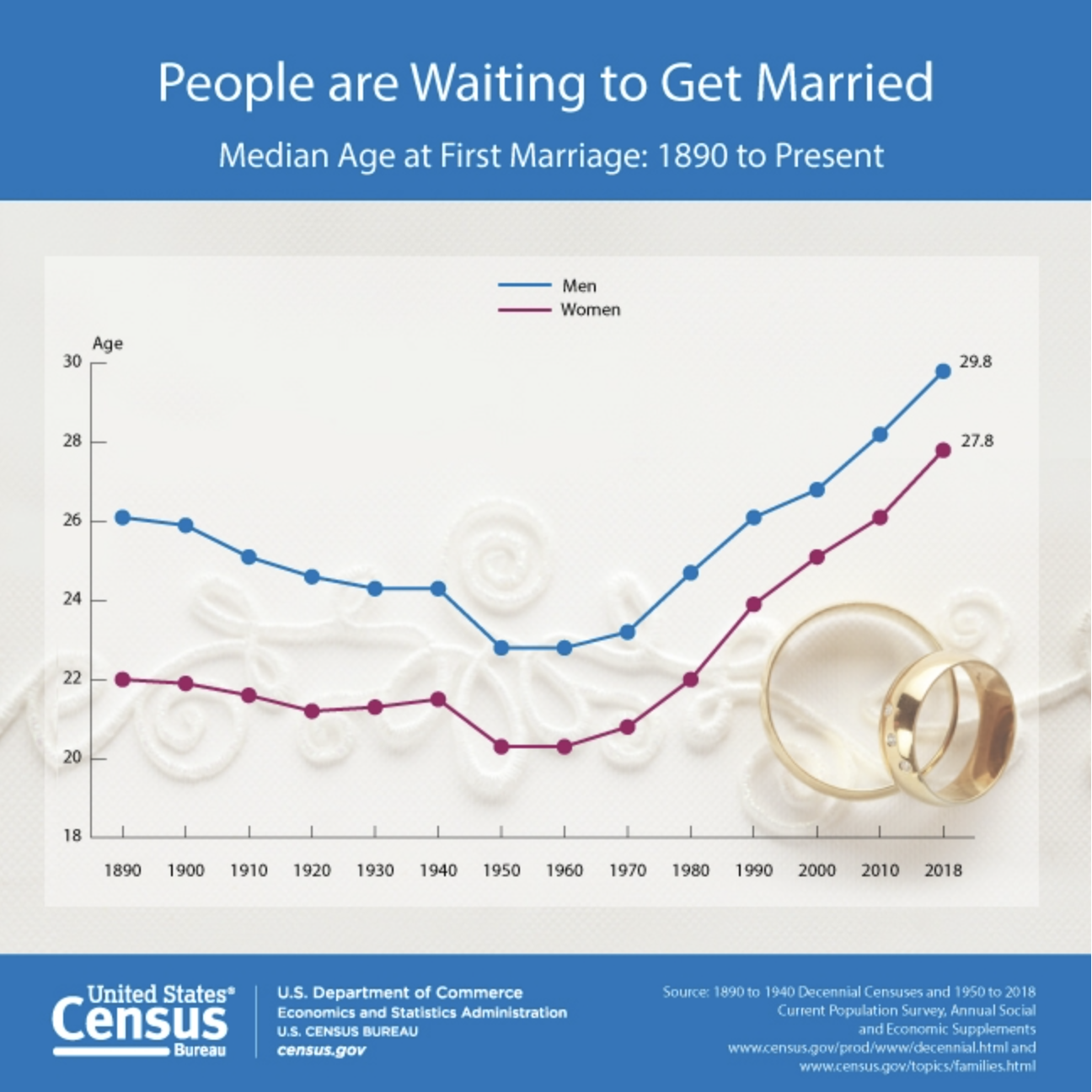
One of the central points raised by the theory of the Second Demographic Transition is that young people in richer countries are growing up with ideas of what to do with their lives besides the time-honored tradition of marrying and having kids. Today the U.S. Census Bureau reminded us of this trend with data from the Current Population Survey. Here's the pattern over time in average age at marriage for males and females in the U.S.:

The graph starts back in 1890 when the rise in the age at marriage (relative to earlier years not shown in the graph) was associated with the beginning of the decline in fertility. This was prior to the advent of effective methods of contraception, so delaying marriage (which in those days also meant delaying the onset of sexual activity) was a way of limiting fertility. The post-WWII period changed all of that and set in motion a round of early marriage and childbearing that produced the baby boomers. But the younger generations have been consistently delaying marriage, although not necessarily delaying sexual activity. In the process, they are creating a very different set of family and household relationships than we've experienced before. This is, of course, why family demography is such a key element in modern social science.
The graph starts back in 1890 when the rise in the age at marriage (relative to earlier years not shown in the graph) was associated with the beginning of the decline in fertility. This was prior to the advent of effective methods of contraception, so delaying marriage (which in those days also meant delaying the onset of sexual activity) was a way of limiting fertility. The post-WWII period changed all of that and set in motion a round of early marriage and childbearing that produced the baby boomers. But the younger generations have been consistently delaying marriage, although not necessarily delaying sexual activity. In the process, they are creating a very different set of family and household relationships than we've experienced before. This is, of course, why family demography is such a key element in modern social science.
Saturday, October 13, 2018
The Power of Plants to Save the Planet
The new UN report on the quickness with which climate change will dramatically our lives has attracted more attention than I was worried it would, and I was especially drawn to an article in the Washington Post reminding us that it is not just cars, trucks, and planes that are the problem--we are ruining the environment with our unsustainable pattern of food production.
The human population has reached 7.6 billion and could number 9 billion or 10 billion by midcentury. All those people will need to eat. A sobering report published Wednesday in the journal Nature argues that a sustainable food system that doesn’t ravage the environment is going to require dramatic reforms, including a radical change in dietary habits.
To be specific: Cheeseburgers are out, and fruits and veggies are in.
Global warming has typically been linked to the burning of fossil fuels, but food production is a huge and underappreciated factor, and the new report seeks to place food in the center of the conversation about how humanity can create a sustainable future.I've discussed the planetary benefits of a plant-based diet on other occasions--check out this post from August or just search in the blog for "plant-based". In that August post I comment on the increase in meat consumption in China, which is a wrong-way trend that the whole world needs to reverse. Indeed, I was thinking about that today as I read another Washington Post article about the dilemma faced by North Dakota soy farmers who are caught up in the Trump administration's trade war with China:
For the past decade, North American soybean production has exploded, driven by an intense demand from China. Peterson and other Great Plains farmers directly fed the overseas markets, harvesting more than 243 million bushels in North Dakota, at a price of $2.1 billion in the last market year. The majority of that crop fattened Chinese livestock.If the majority of that crop were to start going to soy-based food for humans (or if farmers were growing potatoes!), we would all be better off and, in fact, that is what we are going to have to do if we are to sustainably feed the next generation of humans and, more generally, sustain life on this planet.
Wednesday, October 10, 2018
Demographics of Global Climate Change
I'm sure that you've seen the report that came out this week from the United Nations' Intergovernmental Panel on Climate Change projecting that the negative impacts of emissions on global climate change are likely to come about even sooner than previously thought. The NYTimes summarizes the report and reactions to it.
The authors found that if greenhouse gas emissions continue at the current rate, the atmosphere will warm up by as much as 2.7 degrees Fahrenheit (1.5 degrees Celsius) above preindustrial levels by 2040, inundating coastlines and intensifying droughts and poverty. Previous work had focused on estimating the damage if average temperatures were to rise by a larger number, 3.6 degrees Fahrenheit (2 degrees Celsius), because that was the threshold scientists previously considered for the most severe effects of climate change.
“This report makes it clear: There is no way to mitigate climate change without getting rid of coal,” said Drew Shindell, a climate scientist at Duke University and an author of the report.Burning coal was, of course, a huge asset to the economic development that has brought us the current global prosperity. The same is true of petroleum. Population and prosperity have grown together over the past two centuries as a consequence not just of the spread of the potato, but because of human ability to harness energy sources. The problem is that both have the potentially disastrous side-effects of putting us on the path to unsustainability with respect to growing food, and putting people on the path--literally--to another home because rising sea levels are swamping the land they live on. As the NYTimes notes we can either act now and try to avoid those disasters, or decide to wait and see how bad the disaster is and act then. We know what to do--switch to sustainable energy sources like solar and wind power, and we need to do it sooner rather than later.
Monday, October 8, 2018
The Demographic Power of the Potato--UPDATED
The European "discovery" of the Americas was amazingly consequential in demographic terms. I discuss this in my text, of course, but a story in today's Washington Post has a pretty good summary of the three key elements: (1) bringing the potato to Europe to help fuel population growth; (2) the spread of disease that killed a huge proportion of the indigenous population; and (3) the enslavement of Africans to work on plantations created by Europeans in the Americas. Let me focus here on the first of these:
UPDATE: Maybe this should really be a PRE-DATE instead of an update, but I just realized that I blogged about the demographic impact of the potato six years ago, based upon a paper just published at that time by Professor Qian, who was quoted in the above Washington Post story. Here's a link to that earlier blog post.
The potato alone gets credit for population booms in parts of northern Europe that paved the way for urbanization and, in turn, fueled the Industrial Revolution. Tobacco had such value it was used as currency in some places. Some American foods became staples abroad, from the tomato in Italy and cassava in Africa to the peppers that became the paprika of Hungary and the curries of India.
Eventually, starting with a group of monks on Spain’s Canary Islands in the 1600s, Europeans figured out how to cultivate potatoes, which form a nutritionally complete — albeit monotonous — diet when combined with milk to provide vitamins A and D. The effects were dramatic, boosting populations in Ireland, Scandinavia, Ukraine and other cold-weather regions by up to 30 percent, according to Qian’s [Nancy Qian, an economics professor at Northwestern University] research. The need to hunt declined and, as more land became productive, so did conflicts over land.If you've read my book, you know that the statement above may give a bit more credit to the potato than it deserves. The potato arrived in Europe at about the same time that the plague was leaving, and at about the same time that the Little Ice Age was receding, thus opening up more farmland for cultivation. Still, were it not for the potato, it is unlikely that the health of the European population would have improved as it did, thus helping to set off population growth that eventually revolutionized the world.
UPDATE: Maybe this should really be a PRE-DATE instead of an update, but I just realized that I blogged about the demographic impact of the potato six years ago, based upon a paper just published at that time by Professor Qian, who was quoted in the above Washington Post story. Here's a link to that earlier blog post.
Friday, October 5, 2018
More Demographic Resources at the Local Level
Thanks to Meredith Gerhardt for linking me to a great source of data about communities in the U.S., based on a compilation of data largely drawn from the Census Bureau. It's called Data USA and it is funded by Deloitte Touche, a global consulting firm. Here's the background they provide:

In 2014, Deloitte, Datawheel, and Cesar Hidalgo, Professor at the MIT Media Lab and Director of Collective Learning, came together to embark on an ambitious journey -- to understand and visualize the critical issues facing the United States in areas like jobs, skills and education across industry and geography. And, to use this knowledge to inform decision making among executives, policymakers and citizens.
Data USA puts public US Government data in your hands. Instead of searching through multiple data sources that are often incomplete and difficult to access, you can simply point to Data USA to answer your questions. Data USA provides an open, easy-to-use platform that turns data into knowledge. It allows millions of people to conduct their own analyses and create their own stories about America – its people, places, industries, skill sets and educational institutions. Ultimately, accelerating society’s ability to learn and better understand itself.The opening page puts the data at your fingertips when you type in a place name:

When you add this to the OpportunityAtlas.org set of data and the USALEEP neighborhood life expectancy project, your ability to know about local demographics and to compare your place with others is all of a sudden genuinely amazing.
Monday, October 1, 2018
Your Neighborhood Shapes Your Children's Lives
I recently blogged about a new website that uses vital statistics data to calculate the life expectancy in your neighborhood. Well, closely related to your health and mortality is your income and overall level of economic well-being. Today the Census Bureau unveiled another very important website that can track the chances of children in your neighborhood being in or out of poverty--with all of the implications that has for their lives. The NYTimes picked up on the announcement:
The research has shown that where children live matters deeply in whether they prosper as adults. On Monday the Census Bureau, in collaboration with researchers at Harvard and Brown, published nationwide data that will make it possible to pinpoint — down to the census tract, a level relevant to individual families — where children of all backgrounds have the best shot at getting ahead.
This work, years in the making, seeks to bring the abstract promise of big data to the real lives of children. Across the country, city officials and philanthropists who have dreamed of such a map are planning how to use it. They’re hoping it can help crack open a problem, the persistence of neighborhood disadvantage, that has been resistant to government interventions and good intentions for years.
“That’s exciting and inspiring and daunting in some ways that we’re actually talking about real families, about kids growing up in different neighborhoods based on this data,” said the Harvard economist Raj Chetty, one of the project’s researchers, along with Nathaniel Hendren at Harvard, John N. Friedman at Brown, and Maggie R. Jones and Sonya R. Porter at the Census Bureau.Be sure to click on all of the links above, because this is really important work. As with the life expectancy website, this is spatial demography at its very best.
Friday, September 21, 2018
Will Demography be Destiny in Texas?
Thanks to Justin Stoler for linking me to an NPR story this morning about the very tight Senate race currently taking place in Texas between Beto O'Rourke and Ted Cruz. Cruz, of course, is the incumbent Senator while O'Rourke is a Member of Congress from El Paso. Cruz's father is from Cuba, although his mother is of Irish-American descent and Cruz himself was born in Canada and is apparently not fluent in Spanish, and he has an American, not Spanish, nickname. By contrast, O'Rourke is not Latino, but is fluent in Spanish and has a Spanish nickname. Which candidate will appeal most to Latinos? And will Latinos turn out to vote? The latter question seems to be the big one in Texas.
So, if O'Rourke is going to win by pulling in Latino/Hispanic voters, he has more work to do than it might seem at first glance. Tonight's debate should prove very interesting in many respects.
While polls show a single-digit race, O'Rourke will need a transformed electorate in order to win in Texas, where no Democrat has prevailed in a statewide race in almost a quarter-century. Specifically, O'Rourke needs to get dramatically more Latinos to show up to the polls in a state where Latinos have far less political clout than their demographic weight would suggest.
"For a couple of decades now there has been a 'demographics is destiny' narrative that has existed," said Manny Garcia with the Texas Democratic Party. "And sadly for many of those years, it seems like base Democrats — communities of color — were taken for granted."
In Texas' urban counties and the heavily Latino counties in the Rio Grande Valley, there's no surge of new Latino voters, according to voter registration data.
Since 2016, there have been single-digit-percentage increases in the number of new voters around the state's four biggest cities of Houston, Dallas, San Antonio and Austin. In the heavily Latino Bexar County where San Antonio is located, voter registration totals have grown by less than 3 percent since 2016.
While Latinos are expected to become the largest population group in Texas by 2020, whether this is the year Latinos cost Republicans a statewide election remains an open question.I happen to have the 2016 ACS data for the U.S. on my computer, so I did a quick check of the ethnic breakdown in the state of Texas as of two years ago. Among all people in the state, Hispanics currently account for 39% of the population, which is slightly less than the 43% who are non-Hispanic whites. If we look just at the population aged 18 and older (voting age), we find that Hispanics are 35% of the population compared to 46% for non-Hispanic whites. Finally, I looked only at citizens aged 18 and older--people who are eligible to vote. Here we find that Hispanics are only 29% of the voter-eligible population compared to 52% who are non-white Hispanics.
So, if O'Rourke is going to win by pulling in Latino/Hispanic voters, he has more work to do than it might seem at first glance. Tonight's debate should prove very interesting in many respects.
Thursday, September 20, 2018
The Spatial Demography of Facebook
Where you are matters just as who you are (your socioeconomic characteristics) matters in life. This is not about geographic determinism; it is about social connectedness. This was illustrated beautifully by a story today in the New York Times highlighting research on the geographic distribution of friends on Facebook.
In the millions of ties on Facebook that connect relatives, co-workers, classmates and friends, Americans are far more likely to know people nearby than in distant communities that share their politics or mirror their demographics. The dominant picture in data analyzed by economists at Facebook, Harvard, Princeton and New York University is not that like-minded places are linked; rather, people in counties close to one another are.
Even in the age of the internet, distance matters immensely in determining whom — and, as a result, what — we know.Distance isn't the only important thing, of course, but since people who are similar tend to live near one another, the effect is amplified. This is a strong reminder that we are social creatures, and that point is made nicely at the end of the article by Mark Granovetter, who was a pioneer in social network analysis:
The patterns in this Facebook data don’t necessarily mean that limited social networks cause worse economic and health outcomes, or that wide-ranging networks produce better ones. But other researchers say this data will make it possible in future studies to untangle why they’re related.
“This gives us the first way to systematically look at some of those relationships,” said Mark Granovetter, a sociologist at Stanford who has written influential papers on the value of social networks. “They have just scratched the surface here.”
Friday, August 31, 2018
Max Roser and Our World in Data
Over time I have regularly given shout-outs to the great work that Max Roser and his team at Oxford University do in assembling and presenting data for the world around us--focusing heavily on demographically-related themes (remember, indeed, that nearly everything is connected to demography!). There is no time like the start of the Fall term to go online and access these resources. You could start with the graphs of world population growth, such as:

Or, you may want to start with a YouTube video sponsored by Bill Gates, focusing on the important demographic work that the Bill and Melinda Gates Foundation does around the world:

And there's lots more. Browsing these resources is a great way to start the term.

Or, you may want to start with a YouTube video sponsored by Bill Gates, focusing on the important demographic work that the Bill and Melinda Gates Foundation does around the world:

And there's lots more. Browsing these resources is a great way to start the term.
Tuesday, August 21, 2018
Gen Z about to Outnumber Millennials Globally
Thanks to Todd Gardner for the link to a story in Bloomberg about their analysis of data from the United Nations Population Division in which they find that, at the global level, members of Generation Z are projected to outnumber Millennials by next year. Here we have demographic metabolism on display:

And the second point is that not everyone agrees on the exact definition of the generations.
Gen Z will comprise 32 percent of the global population of 7.7 billion in 2019, nudging ahead of millennials, who will account for a 31.5 percent share, based on Bloomberg analysis of United Nations data, and using 2000/2001 as the generational split.Does that matter? With social, political, and economic changes taking place at a pretty rapid pace it almost certainly affects you to be growing up in a "different world" than previous generations.
Gen Zers have never known a non-digital world and have grown up amid events such as the "war on terror" and Global Recession. "The key factor that differentiated these two groups, other than their age, was an element of self-awareness versus self-centeredness," according to “Rise of Gen Z: New Challenge for Retailers,” a report by Marcie Merriman, an executive director at Ernst & Young LLP. Millennials were "more focused on what was in it for them. They also looked to others, such as the companies they did business with, for solutions, whereas the younger people naturally sought to create their own solutions."There are two things to keep in mind in thinking about this generational transition. The first is that it is occurring earliest in developing countries that have higher birth rates and thus a younger age structure, as you can see in the map below:

And the second point is that not everyone agrees on the exact definition of the generations.
For this Bloomberg comparison, millennials were defined as people born in 1980 through 2000, with Gen Z classified as anyone born starting in 2001 -- at least until the next meaningful cohort emerges. The U.S. Census Bureau also bookends the generations at the end of 2000.
William Strauss and Neil Howe, American historians and authors who first coined the term "millennials," use 1982 and 2004 as the cutoff years. The Pew Research Center defines those born in 1981 through 1996 as millennials, a time-frame also used by Ernst & Young in the survey Merriman wrote about.Finally, note that there is money to be made in these kinds of comparisons for those who provide advice based on demographic trends--this is a great example of applied demography.
Monday, August 13, 2018
Horrors at the Borders
The unbearable stories of children being still separated from their parents at the US-Mexico border just because they were trying to gain asylum in this country continue unabated. Over the weekend a plaintive story of a previous migrant was published in the NYTimes, and at least that story seems to be associated with a united outcome.
But while our own border horrors continue, there are others erupting elsewhere. Venezuela is imploding and people want to get out. Who can blame them. The Guardian provides some recent accounts:
But while our own border horrors continue, there are others erupting elsewhere. Venezuela is imploding and people want to get out. Who can blame them. The Guardian provides some recent accounts:
More than half a million Venezuelans have crossed into Ecuador this year as part of one of the largest mass migrations in Latin American history, the United Nations said on Friday. That is nearly 10 times the number of migrants and refugees who attempted to cross the Mediterranean into Europe over the same period. The International Organization for Migration this week announced that 59,271 migrants and refugees tried to reach Europe by sea between January and August, with most coming to Spain, Italy or Greece.
The UN’s refugee agency, UNHCR, said a daily average of up to 3,000 Venezuelan men, women and children had entered Ecuador this year but that the already “massive influx” was now accelerating further.
More than a million Venezuelans have crossed into Colombia since the exodus began in 2015. Others have fanned out across Latin American and Caribbean nations including Mexico, the Dominican Republic and Trindad and Tobago. Tens of thousands have hiked into Brazil down a remote Amazon road known as the Hunger Highway.As is always true, these migrants are creating xenophobic reactions in the places to which they are going. It doesn't matter that they are culturally very similar to the people in the countries to which they are fleeing--they are still different, and that causes problems. So far, however, I have not seen news stories suggesting that any of these migrants out of Venezuela have been separated from their parents. Let's hope that horrible idea doesn't spread.
Monday, July 16, 2018
How Important is Demography in American Politics? Part Two
One of the emerging issues in the increasingly polarized politics of the United States is the demographic divide being created by where people live. In the current configuration of the Republican and Democratic parties, Republicans tend to live in the suburbs and in rural areas, whereas Democrats tend to live in or near central cities. In theory that shouldn't matter when it comes to election time, but this week's Economist provides a civic lesson reminding us that the founders of the U.S. Constitution set up a system that effectively gives greater per-person electoral power to people living in less densely settled areas.
Secondly, with respect to the presidential election, we have this strange thing called an electoral college system:
The source of this discrepancy is that Democrats will win their seats with big majorities in fewer districts, whereas Republicans will prevail by narrower margins in a larger number of districts. In 2016 Democrats who beat Republican opponents won an average of 67.4% of the two-party vote in their districts, whereas Republicans who defeated Democrats received an average of 63.8%. This imbalance is partly due to deliberate attempts to create districts that provide such results, and partly just down to the fact that Democrats tend to live more tightly bunched together in cities. Together, these two factors put up quite an obstacle. According to our model, the Democrats need to win 53.5% of all votes cast for the two major parties just to have a 50/50 chance of winning a majority in the House.
If this imbalance were limited to a single chamber of the legislature, or a single election cycle, the Democrats’ frequent carping about a stacked electoral deck might sound like sour grapes. All electoral systems have their oddities. But changes in where Americans live and contradictions in their constitution—a document designed to work with many weak factions that has instead encouraged and entrenched an increasingly polarised two-party system—have opened gaps between what the voters choose and the representation they get in every arm of the federal government. In recent decades these disparities have consistently favoured the Republicans, and there is no reason to think that trend is going to change on its own.There are three underlying issues here. First, the Senate is deliberately set up so that each state has the same number of senators in order to keep the heavily populated states from dominating that chamber in the way that they can the House of Representatives. That aspect of the system is unlikely ever to change, even though a senator from Wyoming (the least populous state with scarcely more than a half million people) represents fewer than 300,000 people whereas a senator from California (the most populous state with almost 40 million people) represents 20 million persons.
Secondly, with respect to the presidential election, we have this strange thing called an electoral college system:
In all the world’s other 58 fully presidential democracies—those in which the president is both head of state and head of government—the winning candidate gets the most votes in the final, or only, round of voting. But due to the “electoral college” system that America’s founders jury-rigged in part to square the needs of democracy with the demography of slavery, this does not hold true for America. States vote in the college in proportion to their combined representation in both houses of Congress. This set-up means that a candidate who wins narrowly in many small and smallish states can beat one who gets more votes overall, but racks most of them up in big majorities in a few big states.This could be changed, at least in theory, as could the third issue--gerrymandering of districts for the House of Representatives (as well as for many state and local issues). There has been a lot of action on this front, although most recently the Supreme Court has punted.
Sunday, July 15, 2018
How Important is Demography in American Politics?
This week's Economist has a lengthy special report on American politics, focusing especially on the identify politics that have emerged in the widening gulf between Republicans and Democrats in this country. And how could I resist not talking about this article when the author's acknowledgments include being in debt to several prominent demographers whose names have appeared in my book and blog: Bill Frey, Steve Murdock, and Dowell Myers. Indeed, Bill Frey and Dowell Myers were featured in my blog post just a week ago.
The article picks up on the fact that many observers over the years have assumed that as racial/ethnic diversity increases in the U.S. the Democratic Party would benefit more than the Republican Party because the assumption was that Democrats had a political agenda more to their liking. Indeed, there has been a lot of speculation that these kinds of analyses helped to spur on the fears of losing "power" among non-Hispanic whites, helping to propel Donald Trump to the presidency. As I noted last week, Dowell Myers has suggested that the old race-ethnic categories that most of us have been using forever hide the fact that a lot of intermarriage has been going on that has led to people identifying themselves as "white" even though they may indicate on a census questionnaire that they are of more than one race. And, of course, this kind of discussion always reminds me of the very interesting article by Mara Loveman and Jeronimo Muniz: "How Puerto Rico Became White: Boundary Dynamics and Inter-Census Racial Reclassification." American Sociological Review 42(6): 915-939, (2007). Sadly, after Hurricane Maria there were a lot of people on the mainland who didn't even want to acknowledge that Puerto Ricans were Americans, much less white Americans...
Of particular interest in the Economist article is that one of their story lines is that "Demography is not Destiny." This is actually an about-face for a magazine that has probably used the phrase "demography is destiny" more than any other that I know. In this case demography refers to the population characteristic of "race-ethnicity" and the discussion is about the extent to which our self-identified race-ethnicity determines how we think about the world. The best answer is that this is complicated. Race-ethnic categories are social constructs, in the first place, and the whole idea of the American experience is--as the Economist author ends the story--e pluribus unum: out of many, one.
The article picks up on the fact that many observers over the years have assumed that as racial/ethnic diversity increases in the U.S. the Democratic Party would benefit more than the Republican Party because the assumption was that Democrats had a political agenda more to their liking. Indeed, there has been a lot of speculation that these kinds of analyses helped to spur on the fears of losing "power" among non-Hispanic whites, helping to propel Donald Trump to the presidency. As I noted last week, Dowell Myers has suggested that the old race-ethnic categories that most of us have been using forever hide the fact that a lot of intermarriage has been going on that has led to people identifying themselves as "white" even though they may indicate on a census questionnaire that they are of more than one race. And, of course, this kind of discussion always reminds me of the very interesting article by Mara Loveman and Jeronimo Muniz: "How Puerto Rico Became White: Boundary Dynamics and Inter-Census Racial Reclassification." American Sociological Review 42(6): 915-939, (2007). Sadly, after Hurricane Maria there were a lot of people on the mainland who didn't even want to acknowledge that Puerto Ricans were Americans, much less white Americans...
Of particular interest in the Economist article is that one of their story lines is that "Demography is not Destiny." This is actually an about-face for a magazine that has probably used the phrase "demography is destiny" more than any other that I know. In this case demography refers to the population characteristic of "race-ethnicity" and the discussion is about the extent to which our self-identified race-ethnicity determines how we think about the world. The best answer is that this is complicated. Race-ethnic categories are social constructs, in the first place, and the whole idea of the American experience is--as the Economist author ends the story--e pluribus unum: out of many, one.
Subscribe to:
Posts (Atom)